





.jpg)




Samson Doors Glossary of Terms
A B C D E F G H I J K L M N O P Q R S T U V W X Y Z
Access Control - Electronic systems regulating entry, e.g., keypads, card readers, remote fobs, often integrated with automated or security doors.
Acoustic Door - Usually a hinged steel door or roller shutter used primarily to stop noise transmission from one area to another. Their value is measured by a decibel rating.
Aluminium - Material used mainly for various roller shutter door slats and components. Also used for certain profiles of sectional doors, high quality entrance doors and round the corner doors. Ideal material for strength but light in weight, best material to form into curves and profiles not possible with steel.
Anti-Drop Brake - A device fitted inside a roller shutter door mechanism to ensure the curtain cannot drop if there is a mechanical failure of any major component internally. Anti-drop brakes are used in manual and electric roller doors and definitely a requirement for any roller shutter used over a doorway or opening that can be passed through by people or animals.
Anti-Lift Device - Component preventing the door curtain/leaf from being forced upwards from outside.
ATEX Rating - Certification for equipment, including industrial doors and motors, deemed safe for use in explosive atmospheres or hazardous environments.
Automation - The process of converting a manual door, gate, or shutter to power operation using electric motors and control systems.
Awning - A retractable or fixed exterior cover typically providing shade or weather protection, common in outdoor living and commercial shop fronts.
Barrel - The metal tube section used for the roller shutter curtain to roll around. Houses the tube motor for electric single phase doors and springs in spring loaded shutters.
Barrel Motor - An alternative name given to a tube motor used in various types of roller shutter doors and security shutters. It is a long cylindrical motor that sits inside the tube or barrel which the shutter curtain rolls around.
Bi Parting - A door or gate made in 2 sections opening by moving away from each other in the centre. Bi parting doors are used on larger openings or where space might be limited to one or either side of the opening.
Block Frame - A reference used by European manufacturers to describe a fixing sub frame for a hinged door which is used to install the door in-between the aperture. It describes a fixing frame we are generally used to in the UK on most hinged door types used.
Bollard - A sturdy vertical post installed to control road traffic, protect buildings, or prevent ram-raid attacks. Can be static, retractable, or automated.
Bottom Bar - Reinforced lower edge of roller or sliding door, often including safety edges, brush seals, or locking systems.
Bottom Rail - The lowest structural component of a door leaf, gate, or shutter curtain, often reinforced and fitted with weather seals or safety edges.
Bracket - Steel plates used to support the barrel and endplates of a roller shutter or the tracking system of a sectional door.
Brush Seals - Flexible strip fitted to door edges to reduce drafts, dust, and vermin ingress; a common feature in commercial/industrial doors.
BS EN 12453:2001 - Industrial, Commercial, Garage Doors and Gates. Safety in the use of power operated doors – requirements. Includes operational safety of power operated doors including ‘Drawing in’ 'Limitation of forces’ and the drive system.
BS EN 12604:2000 - Industrial, Commercial, Garage Doors and Gates. Mechanical Aspects – Requirements and Classification. Covers the mechanical design of the product including strength calculations, safeguarding against dropping, manual operation forces.
BS EN 13241-1:2003 - Industrial, Commercial, Garage Doors and Gates. Part 1 Products without fire resistance or smoke control characteristics. Main product standard which call up the supporting standards.
Building Regulations - UK statutory instruments that ensure policies are met regarding health, safety, and energy conservation (e.g., Part L for insulation/U-values, Part M for disabled access).
Built In Shutters - A security shutter that is built into the fabric of the door or window opening during construction. The shutter box is usually built into the lintel section above the aperture.
Built On Shutter - A type of security shutter retrofitted and installed to the outside of a structural opening. It can be fitted inside, in-between or outside the aperture and all controls and locking are developed accordingly.
Canopy Door - A type of up-and-over garage door where approximately one-third of the door protrudes outside the aperture to form a canopy when fully open.
Cantilever Gate - A sliding gate system suspended over the opening without needing a track along the ground, ideal for uneven surfaces or heavy traffic areas.
CE Marking - The indication that a product is compliant with EU regulations in order to allow free movement within the European market. It is vital that any major door products are CE marked to ensure compliance in the UK and complete a chain of responsibility and traceability.
CHAS - An accreditation for a supplier/specialist to ensure the supplier meets acceptable standards of health and safety; threshold standard or core criteria. CHAS is established as the market leader for health and safety pre-qualification in the UK. It is available to suppliers (those who provide goods and services) and to organisations (buyers) looking for suitably competent suppliers.
Collective Garage Door - A door used specifically for underground car parks or for the control of high levels of vehicle access. The collective doors are normally up and over, sliding or sectional in their mechanisms with high rated motor drive systems for 24 hour operation.
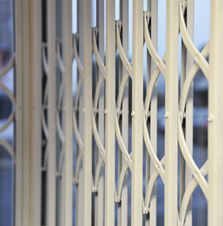
Concertina - Used to describe a retractable security grille or a traditional steel industrial door which travels and slides horizontally to open and close. Common other words used for describing this action are ‘folding’ ‘collapsible’ or ‘zig zag’.
Continental Shutter - A style of roller or security shutter defined primarily by the side guides, endplates and fixing points all being inside the outer edge of the overall product dimensions. In other words the overall width of a continental roller shutter has no other parts wider so it is neater and ideal for many installations where space might be tight or a neat finish is required. The electric motors for continental shutters are usually internal too, such as the tubular motors fitted inside the roller barrel.
Control Panel - The main electrical enclosure housing the logic board and wiring that manages the operation, safety devices, and access controls of an automated door or gate.
CPD - Construction Products Directive. The CPD 89/106/EEC is one of the New Approach Directives. Its aim is to allow the free movement of construction products across Europe. The CPD is a product-specific set of standards, so rather than a generic risk assessment based standard applying to all machinery, each product has its own set of specific standards. From the 21 New Approach Directives that call for CE marking, 5 apply to roller shutter doors. To comply with a New approach directive you must satisfy the essential requirements of the directive. Third party testing, standards and risk assessments are methods by which compliance is achieved.
Crash Door - Flexible, impact-resistant swing doors (often PVC) used in industrial or retail environments to allow fast pedestrian or forklift transit.
Curtain - The main body of a roller shutter door, comprising the interlocking slats or continuous sheet that rolls up around the barrel.
DDA Compliant - Doors and access systems designed to meet the requirements of the Disability Discrimination Act (now part of the Equality Act 2010), ensuring accessible entry for all users.
Deadman Operation - See 'Hold to Run'. An operational mode where the control switch must be continuously held down to move the door.
Decibel (dB) Rating - The standard unit of measurement for sound reduction, used to classify the effectiveness of acoustic doors and shutters.
Direct Drive - A reference to an electric motor which is directly attached to the barrel shaft on a roller door directly driving the opening and closing cycles. Direct drive means there is no chain drive involved and therefore less ongoing maintenance.
Drop Test - A required maintenance safety test for fire shutters to ensure the mechanism descends at the correct speed in the event of a fire.
Electric Gate - A swing or sliding gate operated by an automated motor system, commonly used for residential driveways or commercial premises security.
Emergency Release - Dedicated mechanism for disengaging powered operation quickly, ensuring exit or access in an emergency.
End Lock - Small metal clips or attachments fixed to the ends of roller shutter slats to prevent them from sliding out of horizontal alignment and to reduce wear in the guide channels.
Endplate - A steel or aluminium flat plate with various fixing lugs and profiles integrated to provide a support for either end of a roller shutter door barrel. The endplate support the barrel and enable the hood cover to be fitted too.
Extruded Aluminium - Aluminium pushed through a die to create a specific profile. Used for strong, premium roller shutter slats, guide rails, and bottom slats, offering superior strength over roll-formed aluminium.
Face Fix - An installation method where the door, frame, or shutter guides are installed directly onto the inside or outside face of the opening wall, rather than between the structural opening.
Fascia - A flat single or double skinned insulated material section used to cover a gap between the top of a door panel or frame and the lintel above. Fascias are most often used with roller shutter doors when the roller curtain is installed underneath the lintel and therefore the entire roll would be exposed if there were no fascia fitted in front of the curtain roll. Fascias can be steel, aluminium, Upvc or timber.
Fast Action Doors - Also see ‘High Speed Door’. A reference generally used for a fabric roller curtain used in warehouse, factory and food industry applications where high levels of traffic in and out from the building or from one area to another dictate the need for a fast operating door to reduce weather ingress or heat escaping as well as contamination reduction and improving efficiency with faster flow of traffic for forklifts, etc. Also known as ‘Rapid Roll Doors’
Fire Curtain - A fabric fire resistant roller shutter used to prevent fire and smoke spreading in any building when a fire occurs. Triggered by various methods and generally more discreet than a fire shutter in size.
Fire Rating - Certification or classification of a door’s ability to resist fire (e.g., “FD60” means 60 minutes).
Fire Shutter - A type of roller shutter used to prevent a fire and smoke spreading by having a mechanism triggered by various methods such as heat or more usually these days the fire alarm system itself. The fire shutter is designed to close after the fire alarm is activated after a predetermined time period with closure at a controlled speed of decent. A fire shutter is designed to prevent a fire spreading throughout a building.
Flashing Light - A visual warning device integrated with automated doors and gates that flashes to alert pedestrians and vehicles that the door is in motion.
Galvanised - The process of applying a protective zinc coating to steel components to prevent rusting. The most common method is hot-dip galvanization, in which parts are submerged in a bath of molten zinc. Most steel roller shutter door curtains and components are galvanised as well as steel hinged doorsets, security grilles and many other steel products in physical security and industrial door use.
Gate Automation - The use of rams, articulated arms, or underground motors to open and close swing or sliding gates electrically.
Grille - A physical security barrier with an open-mesh or punched design, allowing maximum vision and airflow whilst maintaining a secure perimeter.
Guide Rail - The vertical steel or aluminium channels installed on either side of a roller shutter or sectional door that keep the curtain or panels securely tracked during operation.
Headroom - The clear internal space required above the structural opening to accommodate the door mechanism, such as the roller box, barrel, or horizontal tracks.
High Frequency Use - Rating identifying doors suitable for constant or very frequent opening/closing (e.g., logistics, fire stations).
High Speed Door - A general term used to describe a roller, sectional or swing door set that operated at a higher speed than normal for the purpose of allowing high levels of traffic in and out from a building whilst retaining cold or heat internally and general weather protection. There is no defined speed and high speed doors will refer to steel doors as well as the most commonly used fabric high speed doors also frequently referred to as ‘Fast Action Doors’ or ‘Rapid Roll Doors’
Hold to Run - Hold to run means that the safety of the electrically powered door is provided by the user, who has to keep constant pressure on a switch. The door will stop when the switch is released. The switch MUST be used in a position that ensures that it can only be used in sight of the door by the person operating.
Hormann - A leading European manufacturer of high-quality domestic and industrial doors, operators, and loading bay equipment.
Impact Resistance - A measure of a door's ability to withstand forceful strikes or collisions without compromising security or structural integrity.
Incline Tracks - A term used to describe the internal tracking on a sectional overhead door which is not set horizontally. The tracks can be set from anything between 90 degrees (horizontal) to 180 degrees going directly upwards and anything in-between are referred to as incline tracks. Making the tracks and door panels follow the incline of the roofline has obvious advantages in terms of providing more internal uninterrupted space.
Induction Loop - Sensor system installed in the ground to detect vehicles approaching commercial/industrial automatic doors or barriers.
Industrial Sectional Door - A heavy-duty overhead door comprising multiple horizontal panels that slide vertically up and then horizontally (or follow the roof incline) back into the building.
Infrared Safety Beams - Either a beam with a reflector or a transmitter and receiver system these are used to provide safety across door openings where electric doors are specified on a control system which can be operated by anyone and the door closes and opens without holding a button or a key in position. If the beam is broken the door stops immediately and usually reverses back up again. It can be one beam or many in a ‘light grid’ system but a single beam is NOT a compliant safety system on its own and should be an enhancement of another safety device in use.
Inverter - A power inverter, or inverter, is an electronic device or circuitry that changes direct current to alternating current. The input voltage, output voltage and frequency, and overall power handling depend on the design of the specific device or circuitry.
IP Rating - Ingress Protection rating. A standard classifying the degree of protection provided by electrical enclosures (like motors or control panels) against dust and water (e.g., IP54, IP65).
Jamb - The vertical side members of a door frame or structural opening.
Jockey Wheel - A supportive wheel used on the leading edge of heavy, wide swing gates to reduce stress on the hinges and motor.
Key Switch - A secure control device requiring a physical key to open, close, or stop a motorised door or shutter.
Keypad - An access control device requiring the input of a numerical PIN code to operate the door or gate.
Kick Plate - A protective metal or plastic plate fitted to the bottom of a door leaf to prevent damage from foot traffic or trolleys.
Laminated - The process of producing an enhanced material in layers. In door terms it refers to the application of a foil coating onto a steel surface to provide wood grain and other metallic finishes to the surface. Entrance Doors, garage doors and roller shutters all have laminated foil coated options which vary from one manufacturer to another even though they may have a similar name.
Lath - The individual horizontal profiles (usually steel or aluminium) that interlock to form the curtain of a roller shutter.
Lintel - The horizontal structural beam spanning the top of the door or window opening, carrying the load of the wall above.
Louvre - A set of angled slats either fixed or hung at regular intervals in a door, shutter, or screen to allow air or light to pass through. Used extensively in steel doorsets where air ventilation is required and known as a louvre door set.
LPS 1175 - Loss Prevention Standard 1175. A widely recognised UK security certification rating the resistance of physical security products (doors, shutters, grilles) against forced entry by various tool categories and time limits (e.g., SR1, SR2, SR3).
Machinery Directive - A directive to enforce compliance with CE regulations within the European and UK community. Covers only machines with a motor of some kind and this includes all powered doors and gates. Since the mid-1990s manufacturers of such products have been obliged to apply the CE marking and issue a Declaration of Conformity.
Magnetic Lock (Maglock) - An electromagnetic access control lock often used on automated gates, pedestrian doors, and access control environments to securely hold a door closed.
Manual Override - A release or system on electric doors allowing operation in case of power failure.
Mullion - A vertical structural element that divides adjacent window or door openings. In industrial doors, removable mullions can be used to divide exceptionally wide openings.
N track - A description used by Hormann UK to describe their torsion spring assembly used on their sectional garage doors. It is a front mounted torsion spring balancing system positioned above the top of the door panels.
Newton Meter (Nm) - A unit of torque used to specify the lifting capacity and power of tubular motors and industrial door operators.
Optical Sensor - A safety device embedded within the bottom rubber seal of an industrial door. If the rubber is compressed, an optical beam is broken, immediately stopping and reversing the door.
Outboard Motor - An electric motor drive situated outside the constraints of the endplates and shutter curtain and barrel. Outboard motors can be situated at a 90 degree angle to the barrel or on the side of the endplate with various gearing arrangements.
Panel Construction - Specifies types (e.g., single-, double-, triple-skinned) and materials (steel, aluminium, composite) affecting insulation, noise reduction, and security.
Panic Hardware - Push bars or crash bars fitted to the inside of fire exit doors to allow rapid, keyless evacuation during an emergency.
PAS24 - A UK security standard for doorsets, indicating tested resistance against forced entry, important for commercial access control.
Pass Door - See also wicket door or access door. It is a small side hinged door built into the larger sectional, roller or sliding door so that people can walk in and out through the pass door without opening the large door.
Pedestrian Door - Access door usually adjacent to the larger doors. Avoids the use of a sectional door as a legal egress and offers easy and safe entry/exit for people on foot.
Perforated Lath - Roller shutter slats that have been punched with thousands of small holes to provide partial vision and ventilation whilst maintaining a high level of security.
Photocell Sensor - Safety device using a beam across the opening; interrupts closing motion if obstructed.
Physical Security - The name used to describe various forms of security shutters, grilles and bars providing an actual barrier to break in in order to prevent the crime rather than alert the crime once a break in has occurred.
Polycarbonate - Durable transparent panel material used for vision sections, glazing, or ventilated doors in industrial/commercial settings.
Powder Coating - A highly durable, dry finishing process used to apply custom RAL or BS colours to steel and aluminium doors, frames, and shutters.
Quick Release - A manual disconnection mechanism on electric gate motors and garage doors allowing the user to manually open the barrier in the event of a power failure.
Radar Sensor - A motion-detecting device mounted above a door used to automatically trigger the opening cycle when a forklift, vehicle, or pedestrian approaches.
Reveal Fix - Also known as 'between fix'. Installing a door, shutter, or frame entirely within the structural opening (the reveal) rather than on the face of the wall.
Roller Door - (also see roller shutter) A door type where the door curtain is constructed from many horizontal sections which roll up and down on a barrel. The roller door curtain is held inside a guide either side. Not to be confused as it often is with a ‘sectional door’ this is one of the most common door types in commercial and industrial use. The use of the ‘door’ part is more often used when the application is for closing off an opening, whether domestic, commercial or industrial and virtually and size.
Roller Shutter - The generic name for any type of door that rolls up and down to provide a barrier and is constructed from individual horizontal slats but can also be a continuous curtain on some models. The word ‘shutter’ is often used more in reference to security shutters or where the ‘roller door’ is used to protect a door or window or even provide sound and heat insulation.
Rolling Code - A security technology used in remote control transmitters that changes the radio frequency code after every use to prevent interception and cloning by thieves.
Round the Corner Door - A type of door where the panels or slats slide horizontally and then turn to continue travelling along the inside of the building. Most round the corner doors will turn 90 degrees into the building but many can take a different angle to optimise space use internally. A popular door for traditional style garages with extra wide openings or low headroom or where pedestrian access may be required frequently so the door can be partially opened.
Safe Edge (Safety Edge) - Pressure-sensitive strip on closing edge, halting/reversing door on contact.
Safety Edge - A safety edge is most commonly a rubber contact strip provided along the bottom edge of an electric powered door that will switch on contact and cause the door to retract to prevent injury or damage. A safety edge is required on any powered door that is NOT a hold to run system and does not have a force list sensor of any other kind.
Sash - A referral to the stack of steel sections on a retractable security grille when it is fully opened. The other name often used is ‘bunch’ or ‘stack’.
SB Rolling Shutter - A reference to a ‘spring balanced’ roller shutter door manufactured by Hormann. It has a tension spring system to one side of the door and a motor driven the other providing a balanced and very safe roller door system with the benefits of low maintenance and reliable safety reverse systems when obstructions are met. The spring balanced system also allows for an easy manual override unlike all other roller shutters.
Sectional Door - An overhead door made of horizontal panels hinged together. The door opens vertically and travels along tracks into the ceiling space, providing excellent insulation and security without out-swing.
Side Hinged Door - A traditional style of door consisting of one or two leaves hinged at the sides, opening outward or inward.
Sliding Gate - A security gate that opens horizontally by sliding alongside the perimeter fence or wall, ideal for locations lacking the depth required for swing gates.
Spiral Door - A new type of rolling door technology which effectively is the combination of a sectional door and a roller door in one. It is a high speed door system opening and closing at speeds of up to 2.5m per second and the real unique benefit is the non-contact technology meaning when the door panels roll up they do not touch each other at any point. It is an insulated, high speed and very secure door.
Steel Doorset - A complete door system including the steel door leaf, steel frame, and pre-fitted hardware, heavily used in commercial, security, and fire-escape applications.
Swing Gate - A gate that opens by swinging on hinges fixed to pillars or posts, similar to a standard internal door.
Thermal Break- A structural element in door/frame design that separates interior and exterior metal surfaces, dramatically reducing heat transfer and improving insulation performance.
ThermoFrame - A Hormann reference for additional weather sealing on a sectional overhead door. The seal system provides a thermal break between the frame and the brickwork / steelwork and will give up to a 21% better thermal insulation value.
Three Phase (3-Phase) - A 400V industrial electrical supply providing consistent, high power. Commonly required for heavy-duty industrial door motors and high-frequency use.
Torsion Springs - Springs mounted above the door opening. Torsion springs are tensioned manually when the door panels are fitted and then set to the shaft which runs through the spring. The spring turns the shaft, which raises or lowers the door via the cables winding on drums. These are the usual method of counterbalancing a sectional overhead door or domestic canopy garage door.
Track - Steel tracks provide a guide for the roller wheels of a sectional overhead type door. The vertical track is mounted to the structural opening with brackets on each side of the door opening. The horizontal track is supported from either above or the side and has a curved section leading into the vertical track section. In the closed position, the door is held and resting in the vertical track. In the open position, the door is suspended from the horizontal track. Sectional door tracking can also be inclined.
Tubular Motor - A compact, cylindrical electric motor installed directly inside the barrel of a roller shutter or awning.
UKCA Marking - UK Conformity Assessed. The post-Brexit product marking requirement replacing the CE mark for certain goods, including industrial doors and machinery, placed on the market in Great Britain.
Up and Over - A door type where the whole door panel opens up as one piece and in its movement goes upwards and tilts over into the aperture. Usually domestic garage doors but also available are commercial car park up and over doors with high usage.
U Value - Measurement showing how well a door or window insulates—the lower the U value, the better the insulation.
Variable Speed Drive (VSD) - A motor control system allowing an industrial door to open rapidly but slow down smoothly before closing fully, reducing wear and tear on components.
Vent Lath - A shutter slat designed to allow airflow, often used in car parks or plant rooms to disperse exhaust fumes or heat.
Vision Panel - Glazed area within solid doors offering visibility but retaining security/insulation.
Vision Slats - A reference to slats within a roller door curtain where either holes or larger sections have been made into the slat to provide vision and also ventilation. The use of vision slats is common in security shutter for retail outlets or any application where high levels of ventilation may be required such as an underground car park.
Weather Seal - Rubber, brush, or vinyl strips fitted around the perimeter of a door to prevent the ingress of wind, rain, dust, and pests.
Wicket Door - a smaller door set inside the large door for pedestrian access without having to open the main door.
Wind Load - The measurement for the amount of pressure a door can withstand which provides data to help specify the correct door on a building. It is the measurement of the lateral forces exerted on any door when fitted.
Wind Lock Guides - A type of guide used in a roller shutter door to lock the roller curtain onto the side guides and prevent the curtain being blown out on high winds or forced out in an attempted break in. Different methods are used for achieving this wind lock status but they are recommended more and more in modern shutters to prevent damage in high winds.
Wind Resistance Classification - Engineering rating showing tested resilience to wind pressure—a key spec for exposed industrial installations.
Wire Rope - Heavy-duty steel cables used in conjunction with lifting drums and torsion springs to hoist sectional doors and certain large shutters.
X-Ray Door - A specialist doorset lined with lead, used in medical and industrial environments to prevent the transmission of radiation.
Yield Strength - The amount of stress a steel or aluminium door component can withstand before it begins to permanently deform. A critical measurement in the engineering of wind-resistant doors.
Z track - A description used by Hormann UK to describe their spring mechanism used on the single sized sectional garage doors. The Z track system uses side mounted tension springs either side of the garage door panels.
Zinc Plated - A method of protecting steel components against corrosion by applying a thin layer of zinc. Used for internal brackets, tracks, and fixings.